Chapter Two
The Prayers of Moses
With the founding of Israel as a nation, the Patriarchal Period ended and God began dealing with His people under a national covenant given to Moses at Sinai. Yet access into God’s presence was no more difficult than it was before. God is ever seeking to restore fellowship with humankind, even though He may at various times use different means to provide forgiveness for sin and to commune intimately with those who obey His word and desire to know Him.
Of all the personalities of the Old Testament who engaged in prayer to the Lord, it is doubtful that any can compare to Moses, either in results of prayer or in profound impact on the theology of prayer. We might well expect this, for Moses prophesied that another prophet like himself, whom Peter identified as Christ Jesus, would be raised up as God’s voice to His people: “ ‘The Lord your God will raise up for you a prophet like me from among your own people; you must listen to everything he tells you’ ” (Acts 3:22; cf. Deut. 18:18).
Prayer and communication with God were virtually Moses’ sole occupation, especially following his emancipation of Israel from Egyptian bondage. His ear was so tuned to God that Scripture is peppered with the phrase “as the Lord commanded Moses.” The expression can be found eighteen times in Exodus 39 and 40 alone. Moses’ entire life as Israel’s leader and deliverer was marked by intimate communion with God. (Although the scope of this study will not permit the examination of every instance of dialogue between God and Moses, such a study would be immensely rewarding.)
Although it is not mentioned in Scripture, Moses’ praying very likely began at the knee of his godly mother. This habit, along with his early knowledge of the experiences of Abraham, Isaac, and Jacob, provides the clue to understanding his superior godly stature that manifested itself so profoundly in the face of unbelievable pressures and temptations:
By faith Moses, when he had grown up, refused to be known as the son of Pharaoh’s daughter. He chose to be mistreated along with the people of God rather than to enjoy the pleasures of sin for a short time. He regarded disgrace for the sake of Christ as of greater value than the treasures of Egypt, because he was looking ahead to his reward (Heb. 11:24–26).
Responding to God’s Call
The first record of Moses’ praying is found in Exodus 3. God, however, took the initiative here, for it was God who spoke first.
Moses was tending the flock of Jethro his father-in-law, the priest of Midian, and he led the flock to the far side of the desert and came to Horeb, the mountain of God. There the angel of the LORD appeared to him in flames of fire from within a bush. Moses saw that though the bush was on fire it did not burn up. So Moses thought, “I will go over and see this strange sight—why the bush does not burn up.” When the LORD saw that he had gone over to look, God called to him from within the bush, “Moses! Moses!” And Moses said, “Here I am” (Exod. 3:1–4).
It should be noted that people never pray so well as when they have first heard from God. This is not to suggest that people should wait for a burning bush before they pray, but rather give attention to the Word of God, which can inspire prayer.
No sooner had Moses responded to God than he was confronted with a divine command: “Do not come any closer” (Exod. 3:5). The order may appear strange at first thought, especially in light of James 4:8: “Come near to God and he will come near to you.” Moses, however, had to learn early that coming near to the mighty God of the universe, who includes in His very essence holiness and justice, requires reckoning with His virtues. In other words, the stage was now set for Moses’ future revelations about access to God.
Though it is well-established that Moses already had an implicit faith in God, it is apparent also that he had gaps in his understanding about God: “Moses said to God, ‘Suppose I go to the Israelites and say to them, “The God of your fathers has sent me to you,” and they ask me, “What is his name?” Then what shall I tell them?’ ” (Exod. 3:13). Believers today have the full revelation of both the Old and New Testaments, but like Moses they have an urgent need for ever greater experiences of His mighty being. Effective prayer and spiritual leadership are largely determined by our perception of God. Consequently, God was pleased to impart to His servant an all-encompassing view of himself: “God said to Moses, ‘I AM WHO I AM. This is what you are to say to the Israelites: “I AM has sent me to you” ’ ” (Exod. 3:14). “I am” is a Hebrew form indicating progressive action. It really means “I will demonstrate who I am by what I will do.” In verse 12 the same Hebrew word is translated “I will be,” and thus the name of God is closely connected with the promise “I will be with you.”
God then went on to reveal what He would do to deliver Israel. One would think that with such a fresh and awesome revelation of God, Moses would have been so assured as to face his new challenge with utter confidence. But it was not so. Nor do our perceptions of God, be they ever so lofty, inoculate us from fear of our own inadequacies. Often the opposite is true: the greater our vision of Him, the great I AM, the greater our vision of ourselves as I-am-nots.
Moses had two major concerns, both of them springing from his new assignment. First, he confessed, “I am not able to contend with the unbelief of the people” (see Exod. 4:1). Then, he complained, “I am not eloquent” (see Exod. 4:10). But for each of these feelings of inferiority, God had an answer. For every “I am not,” God has an “I am.” For Moses there was to be supernatural manifestation and supernatural enablement. Should we expect less today? “The disciples went out and preached everywhere, and the Lord worked with them and confirmed his word by the signs that accompanied it” (Mark 16:20).
Timing of Divine Intervention
Moses set out on his mission. One might expect that with God’s clear call and positive assurance of enablement, the promised deliverance of Israel would occur without any faltering. Many today tend to make that wrong assumption, and some, when things do not go as anticipated, despair totally and lose heart. But God views the circumstances differently: “ ‘For my thoughts are not your thoughts, neither are your ways my ways,’ declares the LORD. ‘As the heavens are higher than the earth, so are my ways higher than your ways and my thoughts than your thoughts’ ” (Isa. 55:8–9).
Instead of an immediate and miraculous deliverance, Moses found the exact opposite. Israel’s plight grew worse instead of better, and Moses himself received the complaint and wrath of the people: “When they left Pharaoh, they found Moses and Aaron waiting to meet them, and they said, ‘May the LORD look upon you and judge you! You have made us a stench to Pharaoh and his officials and have put a sword in their hand to kill us’ ” (Exod. 5:20–21).
Those who pray today often confront such delays. Why should that be? We can only say that such a deliberate, divine delay has often proven to be a demonstration of divine wisdom beyond human comprehension.
When Moses could not understand, he prayed. Note the passage closely: “Moses returned to the LORD and said, ‘O LORD, why have you brought trouble upon this people? Is this why you sent me? Ever since I went to Pharaoh to speak in your name, he has brought trouble upon this people, and you have not rescued your people at all’ ” (Exod. 5:22–23).
The providence of God is certain, though His timing may, and often does, generate human perplexity. With our human limitations we see dimly, and then primarily only the present. But God has the whole scene in clear view: the multiplied complexities, the past and present and future aspects, and the many and complicated actions and reactions of people. We dare not charge God with unreasonableness or injustice. “ ‘Will not the Judge of all the earth do right?’ ” (Gen. 18:25).
Do not forget that Egypt had served Israel well. It had provided food during Israel’s time of famine. It had honored a Hebrew, Joseph, with the highest office in the land next to the pharaoh. It had made room for Israel and its growth, preserving God’s people for four hundred years. True, Egypt had exploited Israel under the new pharaoh, enslaving the people and laying impossible burdens upon them. Nevertheless, God was merciful toward the oppressors of His people; His justice allowed time and space for repentance. Longsuffering and patient, He was and is unwilling that any should perish (see 2 Pet. 3:9).
But judgment will not wait forever. In His time, God does act:
Then the LORD said to Moses, “Now you will see what I will do to Pharaoh: Because of my mighty hand he will let them go; because of my mighty hand he will drive them out of his country.”
God also said to Moses, “I am the LORD. I appeared to Abraham, to Isaac and to Jacob.… I also established my covenant with them to give them the land of Canaan, where they lived as aliens. Moreover, I have heard the groaning of the Israelites, whom the Egyptians are enslaving, and I have remembered my covenant.
“Therefore, say to the Israelites: ‘I am the LORD, and I will bring you out from under the yoke of the Egyptians. I will free you from being slaves to them, and I will redeem you with an outstretched arm and with mighty acts of judgment. I will take you as my own people, and I will be your God. Then you will know that I am the LORD your God, who brought you out from under the yoke of the Egyptians’ ” (Exod. 6:1–3, 5–7).
How difficult it is for people to be patient, to allow God time to accomplish His purpose. Hope seems to die so quickly when evil surrounds us. The present darkness seems to shout, “The sun will never rise again!” Moses spoke to the Israelites as God had instructed him, “but they did not listen to him because of their discouragement and cruel bondage” (Exod. 6:9).
In the end, Pharaoh, the self-centered monarch of Egypt, was without excuse. He had been given every conceivable opportunity to acknowledge and submit to the one true God. He had witnessed God’s might and miracles. He had seen the prayers of Moses answered again and again:
After Moses and Aaron left Pharaoh, Moses cried out to the LORD about the frogs he had brought on Pharaoh. And the LORD did what Moses asked. The frogs died in the houses, in the courtyards, and in the fields (Exod. 8:12–13).
Moses left Pharaoh and prayed to the LORD and the LORD did what Moses asked: The flies left Pharaoh and his officials and his people; not a fly remained (Exod. 8:30–31; see also 9:27–35; 10:16–20).
Finally Pharaoh reached the point of no repentance. There is a time to pray, and there is a time when further prayer is to no avail. John calls it “a sin that leads to death” (1 John 5:16). Pharaoh and his servants had sinned unto death and had sealed their fates. Entreaty could no longer help. Pharaoh had cut himself off from divine mercy, saying to Moses, “ ‘Get out of my sight!… The day you see my face you will die.’ ‘Just as you say,’ Moses replied, ‘I will never appear before you again’ ” (Exod. 10:28–29).
While there is still the slightest hope, prayer should be made. But when every possibility of an answer has fled, one must commit the circumstance to God.
Prayer—Then Action
Moses knew from repeated experience that when he prayed, God acted. But prayer is not the only thing God expects of a person. Along with believing prayer must come action, a stepping out in faith.
Moses answered the people, “Do not be afraid. Stand firm and you will see the deliverance the LORD will bring.… The LORD will fight for you; you need only to be still.” Then the LORD said to Moses, “Why are you crying out to me? Tell the Israelites to move on” (Exod. 14:13–15).
Coming against Israel from the rear was the enraged Pharaoh and his well-equipped army; in front of Israel was the formidable Red Sea. On Moses rested the burden of a vast and despairing multitude. As was his custom, Moses cried out to the Lord; and as usual, he got an answer: “Quit crying and act! Tell the children of Israel to go forward.”
Moses had ordered, “Stand firm.… Be still [remain at rest].” But God gave marching orders, “Move on!” There is a subtle danger in passivity, in a let-God-do-it attitude. Yes, there is a time to stand still, to do nothing but rest; but a command to action must be obeyed.
Although God gave a command contrary to the one Moses gave, we must not overlook the demonstration of faith in Moses’ command. Though the Israelites went out of Egypt “armed for battle” (Exod. 13:18), God recognized that they were not ready for war (13:17). As slaves in Egypt they had received no training for it. Also, they had women and children with them. A professional army could have made quick work of them. But Moses placed his confidence in God. God would deliver them. Moses believed this, even though God had not yet revealed how deliverance would come.1
God generally works through people, not apart from them. Our temptation when we pray, as it was with Moses, is to repudiate responsibility, to hope that in some mysterious way God will do what He has already commissioned us to do. But God will not do what He has asked us to do. At His command, we must move on.
Specific and undeniable answers to prayer generate and stimulate faith both in those who observe and in those who pray. “When the Israelites saw the great power the LORD displayed against the Egyptians, the people feared the LORD and put their trust in him and in Moses his servant” (Exod. 14:31). Moses did more than entreat or intercede. He acknowledged God’s intervention and was an example in worship and thanksgiving. His song of praise (Exod. 15:1–19) stirred a worshipful response from Miriam and the women of Israel: “Miriam … took a tambourine in her hand, and all the women followed her, with tambourines and dancing. Miriam sang to them: ‘Sing to the LORD, for he is highly exalted. The horse and its rider he has hurled into the sea’ ” (Exod. 15:20–21). The lesson from their response is obvious: Spiritual leaders must set the example if they are to see followers involved in the celebration of praise.
Continued Dependence on God
Instances of divine intervention are often the forerunners of problems and untenable circumstances. Though we may bemoan this fact of life, it is no doubt aimed toward our ultimate good. No sooner had the rejoicing over Pharaoh’s defeat ended than Moses had to confront new problems: a water shortage, bitter waters, complaining people. A person of lesser spiritual stature, faced with similar difficulties, might have been tempted to blame God foolishly. But not Moses. Prayer was his immediate response and resource. Surely the Lord who had permitted Israel to come into this new crisis would lead them through it. So Moses prayed and received an immediate answer: “… the LORD showed him a piece of wood. He threw it into the water, and the water became sweet” (Exod. 15:25). Years later Moses was to remind the Israelites of how God had used one crisis after another to humble and test them:
“He led you through the vast and dreadful desert, that thirsty and waterless land, with its venomous snakes and scorpions. He brought you water out of hard rock. He gave you manna to eat in the desert, something your fathers had never known, to humble and to test you so that in the end it might go well with you” (Deut. 8:15–16).
Spiritual leadership is costly. It is certainly not for the fainthearted and faithless. When things went well, God received glory; but when things did not go well, the leaders bore the wrath of the people: “There was no water for the people to drink. So they quarreled with Moses and said, ‘Give us water to drink’ ” (Exod. 17:1–2). People tend to see only their circumstances and their leadership—seldom anything beyond. In this crisis they blamed Moses for their plight. From their point of view, Moses (not God) had brought them out of Egypt. They forgot that Moses was only God’s servant. So Moses was the object of their wrath: “ ‘Why did you bring us up out of Egypt to make us and our children and livestock die of thirst?’ ” (Exod. 17:3).
How should spiritual leaders respond when people turn on them? The example of Moses is the one to follow. He might have answered back sharply. He might have argued and explained. He might have succumbed to self-pity and despair. Instead, he did what spiritual leadership must always do: “Moses cried out to the LORD, ‘What am I to do with these people? They are almost ready to stone me’ ” (Exod. 17:4).
Prayer was the one thing Moses could do without fear of doing the wrong thing. To have done any of the things his human nature might have dictated would not have solved the problem. It would only have agitated and inflamed the people more, and Moses might have lost his life. But when he chose to pray, God immediately responded. God knows the right course of action for every situation, and He instructed Moses about what he should do:
“Walk on ahead of the people. Take with you some of the elders of Israel and take in your hand the staff with which you struck the Nile, and go. I will stand there before you by the rock at Horeb. Strike the rock, and water will come out of it for the people to drink.” So Moses did this in the sight of the elders of Israel (Exod. 17:5–6).
Human beings are by nature bound largely by the five senses. What people can see and hold they believe. Consequently, many want to worship a god they can see. They have problems with the invisible. Yet until a person can escape the bondage of the material world, he or she will not rightly relate to the God of the supernatural. Paul captured this truth succinctly: “So we fix our eyes not on what is seen, but on what is unseen. For what is seen is temporary, but what is unseen is eternal” (2 Cor. 4:18).
Perhaps one of Moses’ greatest strengths was his ability to comprehend the invisible God and then relate to Him: “The people remained at a distance, while Moses approached the thick darkness where God was” (Exod. 20:21). The people drew back, but Moses drew near. Darkness is not always evil; in this instance, God was in it. Yet why would God wrap himself in a mantle of thick darkness? Darkness cannot be in God (John 1:5), but He can be in the darkness. Out of the “thick darkness” God spoke to Moses, giving him commandments for the people, instructions on altar building, and promises of His blessing.
The very angels veil their faces before the Lord of Hosts, and feel themselves unworthy to gaze upon the Divine perfections. But where love increases, fear diminishes. Let love grow, and become strong, and glow within the heart like a flame of fire—by degrees fear changes its character, ceases to be a timorous dread, and becomes awe.… Love draws us towards God more than awe keeps us back. Love … rejoices that it may “go boldly to the throne of grace.” … “Moses drew near into the thick darkness where God was.” The loving soul presses towards God—would “see him face to face”—and “know even as it also is known.”2
Moses, the Intercessor
The overwhelming tone of Moses’ praying was totally unselfish. It was concerned primarily with Israel’s relationship with God. This concern for Israel is especially evident in his prayers in Exodus 32.
Interceding for Transgressors
The first of Moses’ prayers for Israel occurred while he was still on Sinai, holding in his hands the tables of the Law, newly engraved by God. God had revealed to Moses the gross idolatry of Israel. His request of Moses seems strange, from our point of view: “ ‘Now leave me alone so that my anger may burn against them and that I may destroy them. Then I will make you into a great nation’ ” (Exod. 32:10).
At that moment Moses faced a painful dilemma. On the one hand he was the advocate for a people who had flagrantly offended divine justice; on the other hand he was the advocate for divine integrity and justice. We should understand that God was neither commanding nor instructing Moses to allow divine justice to run its course. Rather, God was provoking Moses to that kind of advocacy which would justify His sparing Israel and preserve His integrity in the eyes of the Egyptians. The true advocate and intercessor can be an instrument to influence the final outcome: “The LORD relented and did not bring on his people the disaster he had threatened” (Exod. 32:14).
The second prayer (Exod. 32:30–35) followed Moses’ return to the camp of the congregation. God was not going to destroy Israel en masse, as justice seemed to require; but He would sift the congregation and require that individuals publicly declare their allegiance. “He [Moses] stood at the entrance to the camp and said, ‘Whoever is for the LORD, come to me’ ” (Exod. 32:26). The stage seemed set for God’s judgment.
Once again Moses was overwhelmed with the obvious plight of his people. He identified so profoundly with them that he was ready to die with them. Nevertheless, he quickly learned that deep concern for the transgressor’s fearful lot can go only so far. Though he was willing to die for his sinning followers, in the end each of them would (as each of us will) have to give a personal account before the Almighty. “The LORD replied to Moses, ‘Whoever has sinned against me I will blot out of my book’ ” (Exod. 32:33). (The only exception to this divine principle came at Calvary, when God gave His Son to die for the sin of all people. But even now, each person is responsible for receiving or rejecting divine grace and mercy.)
Aaron could well be thankful he had a praying brother. While Moses was up on Mount Sinai receiving the Ten Commandments, Aaron succumbed to the carnal desires of the people in molding the golden calf.
“The LORD was angry enough with Aaron to destroy him, but at that time I prayed for Aaron too.… You also made the LORD angry at Taberah, at Massah and at Kibroth Hattaavah.… I lay prostrate before the LORD those forty days and forty nights because the LORD had said he would destroy you. I prayed to the LORD and said, ‘O Sovereign LORD do not destroy your people, your own inheritance that you redeemed by your great power and brought out of Egypt with a mighty hand.… Overlook the stubbornness of this people, their wickedness and their sin. Otherwise, the country from which you brought us will say, ‘Because the LORD was not able to take them into the land he had promised them, and because he hated them, he brought them out to put them to death in the desert’ ” (Deut. 9:20, 22, 25–28).
If Moses had not been a faithful intercessor, Aaron might have been destroyed as well as the rest of the Israelites. He was fortunate indeed. At the same time, what a sacred responsibility it is for spiritual believers to be intercessors (cf. Gal. 6:1 and James 5:16–20)!
Of special significance is the intensity of Moses’ intercession for Israel. His was no simple “Lord, spare my people” prayer, followed by a hasty “Amen.” Rather it was forty days and nights of awful travail, prompted by the sentence of judgment: “ ‘The Lord had said he would destroy you’ ” (Deut. 9:25). Do we comprehend that as we approach the end of the age difficult times are ahead and God’s judgments will fall on the world? How grave is the need for intercessors who pray as Moses prayed.
Another intercessory prayer of Moses is recorded in Exodus 33:12–23. It was precipitated by God’s declaration to Moses, “ ‘I will not go with you, because you are a stiff-necked people and I might destroy you on the way’ ” (Exod. 33:3). Moses was devastated by this frightening revelation. From the day of his call, he had coveted and counted upon the divine Presence. He had heard God say, “ ‘I will be with you’ ” (Exod. 3:12). Now he was faced with the prospect of being alone, without God’s presence:
Moses said to him, “If your Presence does not go with us, do not send us up from here. How will anyone know that you are pleased with me and with your people unless you go with us? What else will distinguish me and your people from all the other people on the face of the earth?” And the LORD said to Moses, “I will do the very thing you have asked, because I am pleased with you and I know you by name” (Exod. 33:15–17).
The terrible truth is that sinful humanity cannot endure the holy “Presence,” for it can well consume them. The Israelites were in such a sinful state that the justice of God could rightly require their destruction. Moses perceived that there was but one ray of hope—God’s grace. And that became the ground for his plea. He knew he could not plead for Israel on the basis of law or justice. But in his inmost being he was beginning to catch a glimpse of God’s grace and compassion:
The LORD said, “I will cause all my goodness to pass in front of you, and I will proclaim my name, the LORD, in your presence. I will have mercy on whom I will have mercy, and I will have compassion on whom I will have compassion” (Exod. 33:19).
Long before the writer of Hebrews was prompted by the Holy Spirit to pen the truth, Moses had come “with confidence” to the throne of grace, finding mercy and grace to help in the time of need (see Heb. 4:16).
Personal Revelation for the Intercessor
Through God’s marvelous grace Moses gained the reassurance of the Presence (Exod. 33:14); but grace manifested only whets the appetite for more. Thus followed Moses’ bold plea, “ ‘Now show me your glory’ ” (33:18). We might paraphrase his response, “I have had a glimpse; show me more.” What greater prayer could be uttered? Surely this prayer of Moses is a worthy prayer for every child of God, since all believers need an enlarged understanding of the glory and majesty of God.
God was ready to accommodate the prayer (33:19–23). We might paraphrase His response: “Yes, Moses, I will do as you ask, but know that even you cannot bear the full manifestation of My glory. I will permit you enabling glimpses, sufficient for your role as leader of My people. I will enlarge your vision and your faith.” There is encouragement for all believers in this answer to Moses’ prayer.
The word “glory” is somewhat elusive for finite human beings, probably because it encompasses practically all that God himself is. It is almost synonymous with God. Note verse 22: “When my glory passes by” and “Until I have passed by.” God and His glory are inseparable. Where one is, there also is the other. Therefore, Moses saw more than a blinding brilliance. He saw also in the glorious essence of Deity, mercy, truth, holiness, love, patience, and goodness.
[The LORD] passed by in front of Moses, proclaiming, “The LORD, the LORD, the compassionate and gracious God, slow to anger, abounding in love and faithfulness, maintaining love to thousands, and forgiving wickedness, rebellion and sin” (Exod. 34:6–7).
Such a response by God to Moses’ anguished plea adequately equipped His servant for the journey ahead. A new revelation of God inspired a new confidence in his intercessory prayer. Moses could never have prayed the words that next came from his lips if he had not experienced his special and personal revelation of God. God’s response was far removed from His prior determination to destroy the stubborn Israelites:
“O Lord, if I have found favor in your eyes,” he [Moses] said, “then let the Lord go with us. Although this is a stiff-necked people, forgive our wickedness and our sin, and take us as your inheritance.” Then the LORD said: “I am making a covenant with you. Before all your people I will do wonders never before done in any nation in all the world. The people you live among will see how awesome is the work that I, the LORD, will do for you” (Exod. 34:9–10).
Dealing with Human Frailties
A mark of good leadership is the ability to handle crises; Moses got plenty of opportunity to demonstrate his good leadership. Having journeyed from Sinai to Kadesh-barnea, Moses again confronted a crisis. “The people complained about their hardships in the hearing of the LORD, and when he heard them his anger was aroused. Then fire from the LORD burned among them” (Num. 11:1).
Sin and God’s presence are incompatible; they cannot coexist. Moses had earnestly entreated God for His continued presence with Israel, but now ironically that very Presence, like a mighty inferno, was burning among the people. Sin is always fuel for the “consuming fire” (Heb. 12:29). Israel was learning by experience that there is no escaping an offended God, and that only one among them had the ear of God: “When the people cried out to Moses, he prayed to the LORD and the fire died down” (Num. 11:2).
Moses might well have said to them, “Enough is enough. You never learn, so bear the consequences.” Instead, he must have remembered the revelation of Mount Sinai: God is merciful, gracious, longsuffering. Courage for another prayer of intercession rose in his heart. The fire ceased to burn. We too have an Intercessor like that. Bearing the burden of a vacillating people can so cloud a godly leader’s perceptions and so capture his gaze that he begins to express his frustrations instead of trusting God:
He [Moses] asked the LORD, “Why have you brought this trouble on your servant? What have I done to displease you that you put the burden of all these people on me?… I cannot carry all these people by myself; the burden is too heavy for me. If this is how you are going to treat me, put me to death right now … and do not let me face my own ruin” (Num. 11:11, 14–15).
As mentioned in the previous chapter, others of God’s servants have fallen victim to their own frail humanity and have prayed to die: Elijah (1 Kings 19:4), Job (Job 6:8), Jonah (Jon. 4:3). Fortunately, God does not accommodate such expressions, but He does deal with the underlying issues. He knows our frailties. He remembers we are but dust (Ps. 103:14). Though we may have frustrations, He does not condemn. Gently He told Moses He would take of the same Holy Spirit that was on him and put it on seventy elders to share the burden. And there would be no less of the Spirit on Moses. Moses needed to know that the Holy Spirit is powerful enough to take care of any situation. Even in the face of human failure, God’s mercy is still faithful.
Only Moses and Jesus are identified in Scripture as being meek, or humble (Num. 12:3; Matt. 11:29). And humility shines brightest when the jealous and ambitious attack. The proud and self-possessed fight back; the haughty seek revenge. But the humble pray for their adversaries. Aaron and Miriam had criticized their brother, Moses, and had sought to usurp his God-appointed position. In so doing, they provoked God. Miriam, who was the chief offender,3 was punished with dreaded leprosy. A lesser person might have concluded she was receiving her just deserts. But Aaron confessed their sin and pleaded with Moses for Miriam. So “Moses cried out to the LORD, ‘O God, please heal her!’ ” (Num. 12:13).
What an example of praying “for those who persecute you” (Matt. 5:44)! Bishop Hall, the seventeenth-century English cleric, said of Miriam,
Her foul tongue is justly punished with a foul face, and her folly, in pretending to rival Moses, is manifest to all. Moses interceded for his smitten sister. Affectionately and sincerely he pleaded for her. Moses prayed as one who, from his heart, had fully forgiven the jealousy of Miriam and Aaron.4
Note the plea of Moses: “Please heal her.” Although God honored the plea for healing, He was not pleased to grant it immediately. Those who pray for the sick and afflicted can so desire the healing that the reason for the affliction is overlooked. Miriam’s leprosy was the result of a serious offense. Her healing had to be delayed lest a lack of consequence lead to a careless repeat of her sin. She had a lesson to learn.
Israel never seemed to learn from its disobedience and punishment. Yet the compassionate, tenacious Moses never gave up. Despite his almost utter despair earlier, he again became the leader of strength and faith. His concern was no longer with himself, but with God’s reputation and God’s people. This became very clear when God tested him by suggesting that He would destroy the Israelites and start over by making a new nation from Moses.
Moses said to the LORD, “Then the Egyptians will hear about it!… And they will tell the inhabitants of this land about it. They have already heard that you, O LORD, are with these people.… If you put these people to death all at one time, the nations who have heard this report about you will say, ‘The LORD was not able to bring these people into the land he promised them on oath; so he slaughtered them in the desert.’ Now may the Lord’s strength be displayed, just as you have declared: … In accordance with your great love, forgive the sin of these people, just as you have pardoned them from the time they left Egypt until now.” The LORD replied, “I have forgiven them, as you asked” (Num. 14:13–20).
Like Miriam and Aaron, Korah, Dathan, and Abiram presented a challenge to leadership. They instigated an underhanded mutiny, attempting to establish a priestly order apart from divine authority (Num. 16:1–21). In the face of this challenge, Moses perceived the need for (1) confirmation of God’s duly constituted leaders, Moses and Aaron, and (2) judgment upon the usurpers. At the same time, he feared the woeful consequences that were sure to visit the easily swayed congregation. “Moses and Aaron fell facedown and cried out, ‘O God, God of the spirits of all mankind, will you be angry with the entire assembly when only one man sins?’ ” (Num. 16:22). With this prayer, Moses and Aaron agonized in intense intercession. Yet rebellion may become such depravity that no intensity of intercession will deliver from judgment. The earth opened and swallowed the rebels, confirming God’s appointment of spiritual leadership and judging the human effort to usurp authority (Num. 16:31–35).
How utterly fickle people can be. Although judgment had literally devoured the rebels, the very next day “the whole Israelite community grumbled against Moses and Aaron. ‘You have killed the LORD’S people’ ” (Num. 16:41). Surely God’s wrath burns towards such rashness. Paul describes such vain people in Romans 1:32—“Although they know God’s righteous decree that those who do such things deserve death, they not only continue to do these very things but also approve of those who practice them.” Witnessing divine judgment upon the rebels was one thing; defending them was quite another. It virtually solicited God to destroy them (Num. 16:45).
But Moses and Aaron were men of unrelenting prayer and intercession; they again “fell facedown” (16:45). The persistence of the two leaders is an example to be emulated by all spiritual leaders. Focused on the need of the people, Moses told Aaron, “ ‘Hurry to the assembly to make atonement for them.’ ” And Aaron “stood between the living and the dead, and the plague stopped” (16:46, 48).
On another occasion, what were largely a new generation of Israelites were plagued with fiery serpents because of their grumbling: “The people came to Moses and said, ‘We sinned when we spoke against the LORD and against you. Pray that the LORD will take the snakes away from us.’ So Moses prayed for the people” (Num. 21:7). The anguished plea of the people is noteworthy. This is the single recorded incident in which the people openly begged for Moses’ intercession. In their dire emergency they expressed complete confidence in Moses’ intercession. Such confidence had been learned by repeated experience.
But Moses’ prayer was not answered as the people had supposed it should have been. They wanted the serpents removed. God wanted those bitten by the serpents to participate in obtaining the answer. “The Lord said to Moses, ‘Make a snake and put it up on a pole; anyone who is bitten can look at it and live’ ” (Num. 21:8). Prayer is of little value unless it is mixed with faith, and faith is not present where works are absent (cf. James 2:14–18).
Divine Appointment of Leadership
Although the Book of Numbers records the end of Moses’ life and leadership, Deuteronomy provides some further insights related to Moses’ prayer ministry. In Deuteronomy 3 Moses pleads with God: “ ‘O Sovereign LORD, you have begun to show to your servant your greatness and your strong hand. For what god is there in heaven or on earth who can do the deeds and mighty works you do? Let me go over and see the good land beyond the Jordan’ ” (Deut. 3:24–25). Addressing God as “Sovereign LORD,” or “Lord Yahweh (Jehovah),” is significant. “LORD” suggests ownership rights and power. The choice of “Yahweh” (Jehovah), the covenant-keeping name, speaks of the intimate relationship between God and Israel; consequently, there is an atmosphere of grace about it. The impassioned plea is for God to reverse His decision. Moses had flagrantly dishonored and disobeyed God. Having been totally frustrated and provoked by the rebellious Israelites, Moses had failed to declare belief and trust in God and then angrily struck the rock instead of speaking to it (see Num. 20:1–13). As a result, he had evoked God’s harsh response: “ ‘Because you did not trust in me enough to honor me as holy in the sight of the Israelites, you will not bring this community into the land I give them’ ” (20:12).
God’s answer to Moses’ request for reconsideration was no. “ ‘Do not speak to me anymore about this matter’ ” (Deut. 3:26). We are inclined to say, “God, You are too severe. Why not honor Your servant’s request?” We may not fully understand God’s refusal, but we must know that the Sovereign does what is best, not only for His servant, but also for His people. Had God accommodated Moses, it might have generated more rebellion in those who had provoked Moses to his angry reaction. Whatever the case, it is better to pray and be denied than not to pray at all.
“Man is destined to die once” (Heb. 9:27). Everyone will die except Christians who are alive at the Rapture (see 1 Thess. 4:17). Few, however, are told by God the place and hour of their decease as Moses was (see Num. 27:12–13). Yet even in the face of his certain death, the greatness and godliness of this devoted servant again shine forth. Though he had longed to enter the Promised Land, that joy was withheld because of his failure. And even though Moses was denied his request for clemency, he abandoned his personal interests and prayed for the people.
Moses said to the LORD, “May the LORD, the God of the spirits of all mankind, appoint a man over this community to go out and come in before them, one who will lead them out and bring them in, so the LORD’S people will not be like sheep without a shepherd” (Num. 27:15–17).
The very man who had been set over the congregation by God recognized that only God could provide the necessary leadership. What humility! What total awareness of God’s singular ability! Moses might have requested that his successor be a person he had selected, perhaps his own son. But instead, his plea was “May the LORD, the God of the spirits” do the choosing. Only God knows the spirit of a person; thus His choice is always the best.
Here is a valuable lesson in the selection of spiritual leadership. People who look on externals tend to choose on the basis of appearance, education, ability, charisma; God, however, chooses on a totally different basis: He sees the heart. Moses’ example of deferring to God is a worthy pattern for selecting a shepherd for a flock of believers.
Moses was indeed a giant in God’s Who’s Who of Praying People, but he also became God’s agent for revealing, in terms people can understand, the pathway into God’s presence. In its highest manifestation, prayer is finite, sinful people coming into the presence of an infinite, holy God. But the perplexing question arises: How can this paradoxical and apparently impossible connection between the sinful and the holy occur? Even by the most ingenious scheming, no one can placate or escape the judgment of a holy God. None of our “fig leaves” can withstand the “consuming fire.” No one is worthy to approach Him. Then how can we, who are by nature and sinful intent afar off, draw near to a holy God?
Moses was shown the way. Under God’s instruction, he was given a road map, a blueprint, a pattern, explaining the way into the Holy Presence. “Moses was warned when he was about to build the tabernacle: ‘See to it that you make everything according to the pattern shown you on the mountain’ ” (Heb. 8:5).
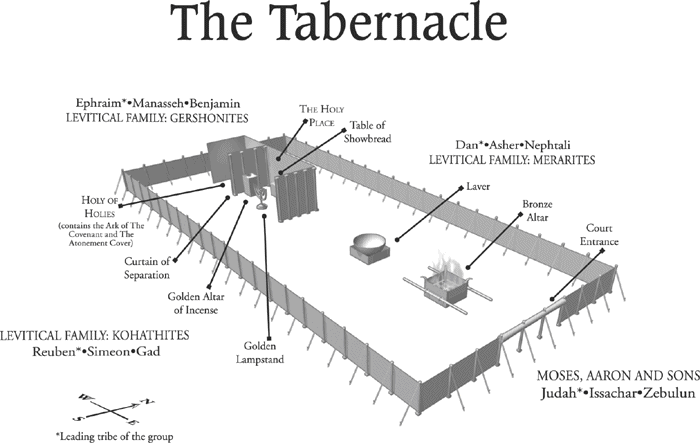
The tabernacle in the wilderness was according to God’s design. It charted the way, step by step, into the Holy of Holies, wherein dwelt the glorious Presence. The tabernacle stood in the midst of the encamped congregation of Israel. Each tribe had its assigned location on either the east, south, west, or north side (see Num. 2:1–31)—except the tribe of Levi, the priests, who surrounded the tabernacle, interposed between it and the other tribes. “ ‘The Levites, however, are to set up their tents around the tabernacle of the Testimony so that wrath will not fall on the Israelite community. The Levites are to be responsible for the care of the tabernacle of the Testimony’ ” (Num. 1:53). East of the tabernacle, Moses and Aaron and his sons camped, “toward the sunrise, in front of the Tent of Meeting. They were responsible for the care of the sanctuary on behalf of the Israelites” (3:38).
At the heart of the encampment was the tabernacle, and at the heart of the tabernacle was the Holy of Holies, where dwelt the presence of God. But though God’s presence was at the center, the ordinary Israelite could not approach Him directly; access was only through a mediatory ministry and a blood sacrifice.
Access into God’s presence, for each Israelite, involved three human elements: the congregation, the general priesthood, and the high priest. Individual members of the congregation brought animals to the east entrance of the tabernacle, indicating their desire to worship the God who was in their midst as well as acknowledging their own sin-laden conscience and dependence upon blood sacrifice for expiation. The Levitical priests were charged with the actual offering of “gifts and sacrifices” (see Heb. 9:9), including both daily sacrifices and those brought by individuals, and with the service of the tabernacle. But only the high priest could make the ultimate atonement and actually appear in the presence of God, and that only once a year. (The diagram provides an elementary understanding of the tabernacle, its setting, and the step-by-step approach to God that it symbolized.)
1. The tents of the Israelites surrounded the tabernacle at a distance. “The Israelites are to camp around the Tent of Meeting some distance from it, each man under his standard with the banners of his family” (Num. 2:2). The expression “some distance” at the very least implies separation between the congregation and their God. Because of their sinful state, the people could approach no nearer than the court entrance unless they were bringing a sacrifice. Then both men and women would come to the entrance of the tabernacle itself. To violate the rule was to invite wrath.
2. Entrance to the tabernacle was limited to the Levitical priests, including the high priest. They entered the court and immediately upon doing so, they encountered the bronze altar where, even for them, a blood sacrifice had to be made before they could proceed farther.
3. The bronze altar required payment. The bronze of this altar (an alloy of copper and tin) symbolized judgment (cf. the bronze serpent in Num. 21:9). Before sinful humanity dared approach the holy God, its sin had to be dealt with properly. The penalty for sin was death—the death either of the transgressor or of an acceptable substitute.
This wholly burnt sacrifice … serves as a solemn proclamation … that every man is deeply guilty before God, and never can approach him or secure his favor except by bloody and consuming expiation. Blood—blood—BLOOD—is the perpetual and exacting cry of the law against every violator of its precepts; and until that cry is hushed, and that demand satisfied, no one can see the face of God, and live.5
4. The laver stipulated cleansing. Beyond the bronze altar, but still outside the Holy Place, each priest who would enter the holy place encountered the laver, or basin, overlaid with the polished bronze from the mirrors of the women (see Exod. 38:8). Intended to reflect any uncleanness or defilement, the basin was a place of necessary and perpetual cleansing. Every priest had to wash before entry into the place of communion, worship, and prayer.
5. The Holy Place contained three items: (a) the table of show-bread (the golden table of the bread of the Presence), foreshadowing Him who is the Bread of Life; (b) the golden lampstand, providing light for activities in the Holy Place, representing the One who lights our pathway toward God, and (c) the golden altar of incense, at the far end of the Holy Place next to the veil, typifying the ascending prayers of God’s people and symbolizing the entering into God’s presence through prayer and praise.
The Levitical priests, except for the high priest, dared go no farther. They could sacrifice, they could wash, they could partake of the bread of the Presence, they could burn incense, but there they had to stop, for before them hung the curtain of separation.
6. The Holy of Holies was the holiest of all places, inhabited by God. It carried for the Israelite the ultimate evidence of God’s presence. The descendants of Adam (who, even after the Fall, bear the image of God [Gen. 9:6] and are thus capable of fellowship with Him) could never be totally fulfilled, or experience fullness of joy, until they could return to that coveted relationship with the manifest presence of God. Yet, for sinners the abode of the “consuming fire” was a most dreaded place. The role of the earthly tabernacle, pointing ahead to the future access of God’s people into the very presence of God, is described in Hebrews:
Only the high priest entered the inner room, and that only once a year, and never without blood, which he offered for himself and for the sins the people had committed in ignorance. The Holy Spirit was showing by this that the way into the Most Holy Place had not yet been disclosed as long as the first tabernacle was still standing (Heb. 9:7–8).
Even though God provided in the pattern of the tabernacle a profound picture of access to himself, His children in the desert never did enjoy the access which is ours today. They had but the shadow; we have the reality. They had the type; we have the fulfillment of that type:
Therefore, brothers, since we have confidence to enter the Most Holy Place by the blood of Jesus, by a new and living way opened for us through the curtain, that is, his body, and since we have a great priest over the house of God, let us draw near to God with a sincere heart in full assurance of faith, having our hearts sprinkled to cleanse us from a guilty conscience and having our bodies washed with pure water (Heb. 10:19–22).
Fortunate are the followers of a praying leader. As the Lord uses you in spiritual leadership, always keep prayer as the highest priority. To conclude your study of this prayer giant of the Old Testament, meditate on his prayer of thanksgiving in Deuteronomy 26 and on his prayer song in Deuteronomy 32 and 33.
Questions for Study
1. Why were some of Moses’ prayers not answered immediately?
2. What factors characterized Moses’ intercessory prayers?
3. Why were some of Moses’ prayers not answered exactly as he asked?
4. What lessons do you learn about prayer and access to God from the study of the tabernacle and its furniture?
5. On what occasions should we not pray?
6. What are some reasons that spiritual leaders must keep prayer as a priority?